Thursday, March 19, 2015

DIGITAL BLOG POST #I chapter 4

DIGITAL BLOG POST #I chapter 4


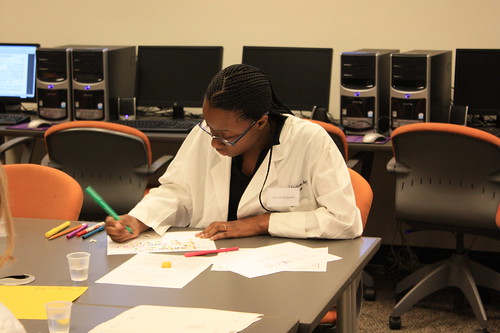
I think with teaching it can tough on teachers, if they don’t have a set lesson plan. Or have an idea of what they going to teach.  So what normally helps is when teachers are using the design and development meaning this is how teacher can create and evaluate their lesson plans. There’s 3 elements to keep in mind when trying to make instructions for classroom. There’s academic content like what to teach, there’s teaching goals and methods, and procedures like how to teach, and learning assessments knowing what the student has learned. This i will help teachers keep their goal in mind in what they want to teach in the classroom.
Flickr credit: thewomensmuseum


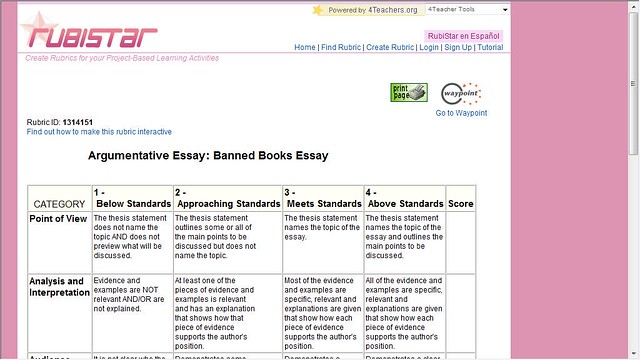
I am so glad Professor Coleman showed us the website RubiStar for making rubrics. It was hard making one on your own but you learn you can do it. It just takes a bit of time that’s all. But for the teachers who need to make a quick rubric this website is amazing you can it make for which ever category you need. Reading, writing, and even music. I am going to use this website when I start teaching, if I feel like I missed something in my rubric I can always go back and edit it. There won't be any hiccups or confusion from my stand point and the students. we will both be able to agree on the points that were given for the type of project that was presented.
Flickr credit:  chelseavanvickle


What I found that was fascinating was the performance assessment. It doesn’t just mean watching and scoring a student's test or paper anymore. It can refer to so many different things now. Like for example art students, there not a lot of testing going on in the classroom, but the student can be can have a performance evaluation on their portfolio, dance routine, or just using their basic knowledge in front of school judges or people that are evaluating them. This will definitely fall on me and some of my other classmates. We might have to be evaluated in the classroom in order to receive our teaching license. This is falls on students and as well as on teachers that have experienced this.


Flickr Credit:  courosa


See what my BitStrip self wants to teach <--------------- I thought it was funny haha :)


Resources:

Maloy, Robert, Verock-O’Loughlin,Ruth-Ellen, Edwards, Sharon A., and Woolf, Beverly Park (2013). Transforming Learning with New Technologies. 2nd Edition. Boston, MA: Pearson Education, Inc.

www.BitStrips.com


Haynes, A. (2007). 100 ideas for lesson planning. London: Continuum.

Haynes, A. (2010). The complete guide to lesson planning and preparation. London: Continuum.


Wednesday, March 11, 2015

DIGITAL BLOG POST #H Chapter 9

DIGITAL BLOG POST #H Chapter 9


When it comes to grabbing the attention of students, I feel like there are so many resources to create this. The 1st that I think of is using PowerPoint. PowerPoint is a type of software that lets you design electronic presentations having a series of pages and slides. Here teachers can get really creative with their slideshows. They can add audio, pictures, even videos. This is usually done with an overhead-projection and a type of transparency sometimes with a slide show with slide. Students and teachers can get really creative with PowerPoint. There is no “wrong” way of using this software. You’ll see that no two PowerPoints are the same. I really liked (and still do use) this program. I can go as extreme with my colors and  font as I want or I can just stay as conservative as I want.


Flickr Credit: garethjmsaunders


When I was in the 4th grade I remember my teacher having a digital projector over-head, I thought that was the coolest thing I had ever seen. I felt like my teacher had the privilege of using that  type of machine in the classroom or she won some kind of raffle to use. I’m super weird but yeah I thought that. But anyways I had learned a lot from that cool looking overhead. From reading and learning how to write a proper paper for the FCAT prompt, understanding math lessons, and just having the teacher explain things on the overhead. It helped a lot. I was able to understand math less because the teacher was doing it step by step and I was able to see it for myself. When the teacher was going over the prompts you can see the type of writing people would write and you can see the examples of what was a good prompt and a bad one, it was actually nice to see the right and wrong on writing prompts.

Flickr credit : Nesster


I want to say I didn’t start using this format of technology til I started college. The iPodcast. This has come such a long way from where the ipod started. I was having such hard time with learning science class like Biology or Chemistry, and the funny thing was I love science. Learning the chemicals, mixture of formulas, and the overall of fascination of it. But I had a tough time with it, the teacher would help but I felt like how they were explaining it I couldn't understand it. So I decided I my iPod and it came with this free app already built in it and you can download lectures and videos. It was such a helpful app that I still use it till today and I recommend it to others to use. If there is a way for others to explain it differently this is the way to go. I use it now for listening to my favorite authors lectures or people that have weekend talk shows. Teachers can use this type of technology for their students and have this provided for students. Maybe one students can find it helpful even if another doesn't understand the material.

Flickr credit:  ~kate~


Flickr Credit:  The Daring Librarian

¿Quieres jugar un juego? Entonces, por favor haga clic en y poner a prueba sus conocimientos .


Tuesday, February 24, 2015

Blog Post #G Chapter 8

Blog Post #G is for Chapter 8


When I was in high school, I had decided to go to summer school but not because I was behind in classes but because I wanted to stay ahead of the game. I had always had a tough time with math, I decided that summer (which was May and June) I was going to take extra math classes and have a tutor. In my classroom, because there was a lot students the teacher couldn't get to all of us would do something similar to a "pencast." It is pretty much a "digital version" of the your notes and has audio. Making it somehow like you where there again re-acting the lesson. This would really help because sometime getting home and having a snack and maybe a nap and when I wake up I would forget how my teacher would do the assignment but I had my pencast on my computer and I would remember how to do it again. This was really helpful not only to me but to other students.


Flickr Credit given to: The Daring Liberian 
Wanna check out a pencast <-------- Click me! ( YouTube Credit is given to Greg Summer)


I really like the idea of teachers sharing information through social media nowadays . If you really think about it, how many parents still go through the child's backpack now? Unless there is a sticker on the child's shirt saying "don't forget tomorrow is picture day," or something like that. Parents have a lot on their mind. But because the world now runs on texting, emailing, or just getting on Facebook, teachers should use this to their advantage and possibly create a Facebook, and have parents check it for any important dates like picture day, the Christmas party or not forgetting there is practice even though it's raining. You know something like this could help a lot of parents stay ahead of the game. I'm pretty sure if I was a parent this would really helpful because kids will throw their backpacks and parents would not think twice to check it and see if they have report cards or their practice schedule.


Flickr credit given : melenita2012

 When I got to college I didn't need to take my sciences till I was a sophomore. I had to take biology and chemistry at the same. ( I know worst mistake ever) But anyway, my professors knew that these subjects were hard for students and the fact that everyone learns differently too. But they did ask feedback from their students and the students did tell the professors that way that the majority learned was watching tutorials on YouTube about certain subjects, but the majority were on science classes. so my professor did have their own YouTube videos about the material we had learned in class. This really helped me and other students because we could watch it over and over again until it stuck in our mind, I know it did for me. I also liked that sometimes they would have students on their YouTube videos sometimes teaching some material, I felt related to that person and for some reason it made sense. 

Flicker credit to: NASA Goddard Photo and Video

Think you're Social Media savy.... well test it out !

Flickr credit:  IDI at NTNU


Resources: 

Maloy, Robert, Verock-O’Loughlin,Ruth-Ellen, Edwards, Sharon A., and Woolf, Beverly Park (2013). Transforming Learning with New Technologies. 2nd Edition. Boston, MA: Pearson Education, Inc.

Mandiberg, M. (2012). The social media reader. New York: New York University Press.

Social Media. (n.d.). Retrieved February 24, 2015, from https://www.rmmcanada.com/social-media-.html


Tuesday, February 17, 2015

DIGITAL BLOG POST #E chapter 7


As a student being in the classroom, sometimes it can be boring. The teachers monotone voice. Like the guy from eye commercial, I know Ben Stein is just acting but that’s how I describe it. Sometimes being in the classroom for a long period of time just makes everything boring and really uninteresting.So what happens is the student leaves and goes home and start playing a game on their phone. Students are learning and not even realizing it. There are so many educational apps for tablets and smart phones. I really like when people are playing an app called “Trivia Crack.” It’s a really fun game, where it involves a lot of different categories from art to history to science, well you get it. But  everyone is playing this and not realizing that it is an education game. Im shocked and surprised that people are getting into. Another learning is called “Duolingo,” what this app is a language educational app. It has different ways of making you understand the language you want to learn.
Ben Stein Photo Credit from: Kat Ruddy 


When I was in elementary school, had we this part of the day where we were placed in certain group and we would go together to rotation. What this meant was that depending the day we either had to go to computer lab, reading cornering, the learning table, or wherever the teacher wanted us to go. For the rest of us the exciting part was being able to go to the computer lab where we got to play “games.” They were educational, needless to say they were games and we got to have a learning break for at least 30 to 45mins. Growing up with these games, I feel had differently made a difference for me. Learning about states with Carmen Santiago, going on educational adventures with the ClueFinders, or learning how to survive in the West with the Oregon Trail people. There were so many games and they each possessed something to learn from. Whether it was math, vocabulary, critical thinking. I loved buying these games and actually using them at home.

                                                                                 photo credit: Vivith Bharath


When our classroom got to go on fieldtrips, we got to go to Imaginarium Science Center.
This place was amazing! I loved the simulations they had. It was all about hands and interacting. It was amazing, to see all the different types of computer generated conflicted choices and goals they give a student. I really like the weather box simulator. What happens is, you are presented with a city and this city has a different environment and you have to protect it from the severe weather. You are given a computer simulator to see if you protected the city well enough if not they actually show you what you could've done instead.


I've made a Trivia game on Kahoot! PLease try it out and see if you guess it right!


Resources:

https://www.flickr.com/

en.wikipedia.org/wiki/The_ClueFinders

http://i-sci.org/


Monday, February 16, 2015

Digital Blog Post #F Chapter 10


It's really amazing to see how Google has come from, first it was just an internet search box but now its a variety of things. It can create blogs, documents, and now it has Google translate. I believe teachers should use this to their advantage especially if they have students that english is not their first language. It’s free and can be download on your phone or used right on the computer. Yes, we all know there are language dictionaries but having the google translater right in the classroom can benefit the teacher and the students. Students can now have the translator handy on their phone or on their computer, while reading an article in a different language or if they see something on the news and didn't understand what it meant or what was going they can go to this app and figure it out.
There are so many tools we can use in the classroom as a teacher. We have come such a long way from where we started. We started out with chalk and blackboard to white erasable boards to now high tech boards with “wireless” markers to write with. We can use all the items we have in our classroom and transform them and have them advance to have students participate with these tools. Like back when I was a kid some odd years we would use paper, pens, and pencils. Now students have the advantage of using tablets schools provide for them, instead of wasting so much paper we can use the tablets and create our ideas right in front of us with color and bring it somehow to life. This I feel would keep the student’s mind involved in what they are doing.
9527140076_23172bd168_z.jpg
Creative Credit from Flicker: IntelFreePress

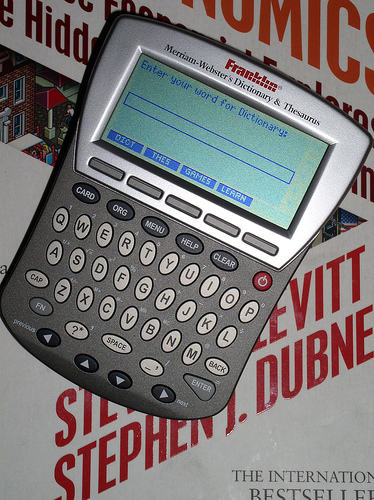
    Spanish is my first language, but when I was in kindergarten I was learning english as a “second” language. It was really hard and I really got frustrated because I wanted to say something but I felt like I was saying it wrong so I practiced my english a lot. I went from Kindergarten to ESOL to ESOL mixed with moving into first grade, then being able to be in the first grade without having my ESOL teachers help me. I had finally “mastered” speaking and learning the english language. But my parents...? That was a completely different story. My dad was a construction worker so he had to pick up on the language really fast and was able to, kinda broken but got it. My mom was a housewife so she didn’t really understand a lot when people would try to talk to her. So what she did was buy herself an electronic speller and dictionary. It was the most greatest device I had ever seen. If she wanted to say a word in english she would write it in spanish and it would translate it in english, thus she was learning words of the english language. I really believe that teachers should use these devices in their classroom. I feel if I had this in my Italian speaking class, I’m pretty sure I would’ve picked up the words my teacher would throw at us. It’s so confusing with trying to say a sentence or even communicate with the teacher. There are usually games on the younger kids version and it makes it fun and get themselves involved with this.
61807777_3cc716ec44.jpg
Creative Credit provided by Flicker: Premshree Pillai

I did make a fun short game on Zahoot, please click the following link to have access to it!
It's called "Guess My Language!"


Monday, February 2, 2015

DIGITAL BLOG POST #C chapter 3


Lesson plans, oh lesson  plans. They are tricky little pieces of paper to write out for. I know there are many teachers that would to teach random subjects. But because of the lesson they do not get off track. I like that teachers can have their students involved with the process of having a lesson plan. Like asking the students to make a lesson and see their ideas and their points of view on the class and where they are. I believe this would want students to become more involved and actually get them excited because maybe their teacher took into consideration their feedback and now are getting their lesson taught in a different way. I seriously think this could open doors and possibly a lot of windows for teachers and students. They could possibly see eye to eye on their subjects now.

I for one have never agreed with standardized testing. Why should one student be compared to another? Just because you have two students of the same age, level,  and in the same subject it does not mean that they will both will have the same test score. One student could do better than the student right next him. After having to take the FCAT till I was in the 10th grade was just mortifying for me. I couldn’t stand the fact that I had to take it in order to pass to another grade level. I felt ashamed and embarrassed because I felt like I had to prove myself to the state, my professors, and for my school. Talk about no pressure there. It was already bad enough that I had to study for different materials and pass, now I had to try to pass this exam without a study guide. Thanks but no thanks, you can keep your standardizing tests.


I really like how the book goes into full on mode details about the student rubrics. I was having a bit of a tough time with understand how to write rubrics so this was a great insider on how teachers should write theirs out and according to the assignment the professor is giving. It’s about having the student or the whole class guidelines and how you would you want the assignment done. I didn’t think rubrics were a “big deal” I would take my professor’s word on whether or not I did well, but then again I know there would be people out there wanting to against the teachers word and fight for a “better” grade.

Image Credit: Dan Morelle


Digital Blog Post #B Chapter 2

Blog B

Visual Learning pretty much supports the idea of projecting information. No matter if it's through software programs, videos, or graphics. This is pretty much how I felt like I would learn certain subjects. I honestly don't know if I would've made it through my difficult classes without visual learning. I know I'm not the only one like this. Everyone is different when it comes to learning. I'm a student currently at FSW. I did my Associates Degree, but I was having a tough time with my science classes like microbiology and chemistry. No matter how hard I studied the material or the study guide I couldn't understand it. So I started watching videos on youtube. Watching these videos as other students were explaining the material, some how made more sense to me. Seeing it in a different way made a huge difference to me.

There are so many different techniques for a student to learn whether its in a group, alone, or a tutor. I can consider myself to be diverse with this. I can work well with others, or sometimes i prefer to work alone. But working with a teacher or tutor I felt there was so much pressure to understand the concept they are trying to help you with. You either had to learn it right away or you were considered “slow.” I’ve always this fear with teachers or tutors that I had to pick it up real quick. Then I met my math tutor my sophomore year, and he made me see tutors in a different light. He was really understanding that I couldn’t pick things up super fast, he understood I like taking my time to understand and learn the concept. I no longer have this fear of tutors or coming up to my professors.

Image credit to: BitStripes
By definition creativity means “the use of the imagination or original ideas, especially in the production of an artistic work.” I really like this definition, but people now and days have different ideas about what creativity means. It can mean someone is gifted with being able to build or sculpit masterpieces. To me is can mean the person themselves are just gifted with some type of gift, if that makes sense. Some are meant to paint while others have a natural act for being able to read plays beautifully. I feel that everyone can use their talents for some greater good. People that can paint, they could possibly teach an art class to people that need an outlet of their everyday lives. People can inspire others with their reading of William Shakespeare's plays. You can not just “define” creativity.